
Safer Using
Safer Using – Ketamine
About Ketamine Ketamine (also known as ket, K, special K, or horse tranquiliser) is a dissociative anaesthetic belonging to…
DOx (short for substituted dimethoxyamphetamines) is a class of psychedelic drugs that are chemically related to amphetamine.1,2 DOx drugs are known for their high potency (dosed in milligrams), intense psychedelic effects with moderate stimulation, and very long duration of action (12-30 hours in total).1-3 DOx drugs are most often sold on blotter paper (tab), but may also be sold as pills, liquids, or powders.1-3 DOx drugs are sometimes sold online as “research chemicals” (or RCs).3
The class includes:1,2
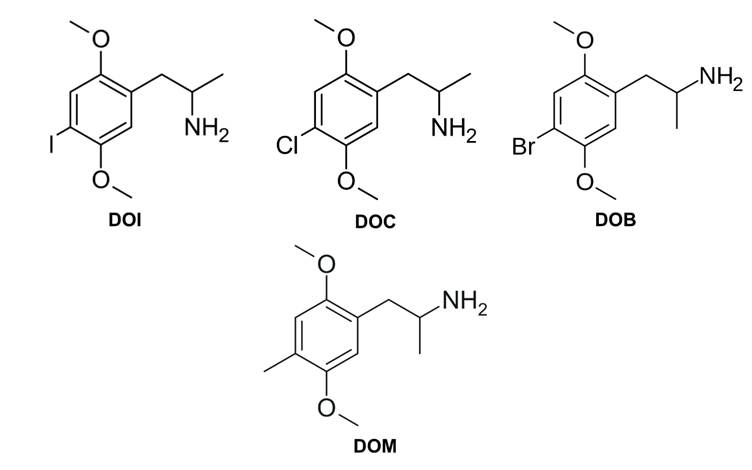
Due to their high potency, DOx drugs are one of the few drugs classes, alongside LSD derivatives and 25x-nBOME, that can be distributed on blotter paper (tabs).1,2 As such, they can be erroneously sold as LSD or “acid”.1-3 Compared to LSD, DOx drugs have a significantly longer duration of effects and come-up time (up to 3-4 hours), leading some users to think they have a “bunk batch”, taking more to compensate, and accidentally overdosing.1,2,4 Always consider testing your drugs before you take them by using a DIY test kit (e.g., https://dancesafe.org/product/lsd-testing-kit/), or by taking it to a drug checking service such as CanTEST.
DOx drugs exert their psychedelic effects by activating 5-HT2 serotonin receptors (particularly 5-HT2A), which is the same receptor responsible for the effects of classical psychedelics including LSD, DMT, and psilocybin.3,5 Some of their effects may also be mediated by dopamine receptors, but to a much lesser extent than LSD.5 There is very little research into the safety and toxicity of DOx drugs in humans.
The DOx class of drugs was first synthesised and described by the chemist Alexander Shulgin in the early 1960s.4,5 In the late ‘60s, DOM—one of the first drugs in the class—was distributed in the San Francisco drug market under the name “STP” (short for “Serenity, Tranquillity, Peace”).4,5 The name “STP” reportedly came from a motor oil additive (“Scientifically Treated Petroleum”) to which some users mistakenly attributed the psychedelic properties.4 Shulgin synthesised many other drugs of the class including DOB.4
In 1972, researchers at the University of Alberta synthesised the drugs DOI and DOC based on the work of Shulgin.3,5,6 DOI became an important compound in scientific research, playing a pivotal role in understanding the serotonin receptor and the pharmacology of various drugs including psychedelics.5 DOI was one of the first drugs found to bind to 5-HT2 receptors, the class of serotonin receptor responsible for the effects of classical psychedelics.5
The effects of psychedelics can be highly variable, depending heavily on a person’s mindset and environment (“set and setting”). To minimise the potential for negative experiences, it is important a person feels safe in their environment and is accompanied by familiar people. In highly stimulating environments such as music festivals, a person may need to spend time in a quiet space away from sensory stimulation. It can be helpful to find such an area before taking psychedelics.
The effects of DOx drugs can include:1,2
The effects of DOx drugs are notoriously long-lasting. The total duration of effects can be 12-30 hours in total with the peak lasting 6-12 hours.1-3 Moreover, the effects can take a long time to come on, generally 2-4 hours.1 Hence, it is important to wait several hours before considering redosing.
DOx drugs can take a very long time to kick in (several hours) and it is impossible to verify the dose of a DOx drug present on a tab. Hence, it is important to start at a low dose and wait before redosing (start low and go slow). It is recommended to start with half or even a quarter tab to minimise the risk of accidental overdose.
DOx drugs may vary slightly in potency, and thus their dosage, but they are mostly similar.1,4 DOC, DOB, and DOI may be slightly more potent than DOM.1,4
The following is an approximate dosage guide for DOC:1,3
| LOW DOSE | 0.5-1.5 milligrams |
| MODERATE DOSE | 1.5-3.0 milligrams |
| STRONG DOSE | 3.0-6.0 milligrams |
Generally, the R-enantiomers (the right-handed mirror image compound) of DOx drugs are more potent than the S-enantiomers, but there is unfortunately no way for users to verify which enantiomer they are taking.3,4
Mixing drugs can increase the risk of side effects and overdose. Extreme care should be taken if mixing DOx drugs with other stimulants (e.g., MDMA) or cannabis to avoid unpleasant experiences or overdose.1,3,7 The following combinations should be avoided:1,3,7
This list is not exhaustive, and other drug combinations may have unpredictable and dangerous effects.
The symptoms of a DOx overdose can include:3,8
If someone is experiencing these symptoms, ensure the person is in a safe environment, monitor for improvement or deterioration, and stay with them until the symptoms resolve. Seek medical attention if you are concerned.
Seek emergency medical attention (call 000) if someone experiences any of the following symptoms:3,8,9
A severe DOx overdose can be life-threatening, especially when combined with other drugs.3,8 It may lead to complications such as:3,8
[1] https://psychonautwiki.org/wiki/DOx
[2] https://wiki.tripsit.me/wiki/DOx
[3] https://ecddrepository.org/sites/default/files/2023-04/final_doc.pdf
[4] https://erowid.org/library/books_online/pihkal/pihkal.shtml
[5] https://doi.org/10.1021/acsptsci.4c00157
[6] https://cdnsciencepub.com/doi/pdf/10.1139/v73-210
[8] https://doi.org/10.1007/s11906-018-0807-9
[9] https://doi.org/10.1001/jama.1983.03330350053028
Written by Darcy Lynch
About Ketamine Ketamine (also known as ket, K, special K, or horse tranquiliser) is a dissociative anaesthetic belonging to…

About Vaping Vaping is a method of consuming drugs using a battery-powered handheld vaporiser, commonly called a vape. This…

About MDMA MDMA or 3,4-methylenedioxy-N-methylamphetamine is a stimulant drug known for its ability to produce intense feelings of euphoria…